What Does Good Friday Truly Mean? –
A Deep, Historical, and Spiritual Exploration
What is the true meaning of Good Friday? Explore its historical, theological, and spiritual word biblical reflection on the most sacred day in Christian history.
1. Introduction: A Question That Pierces the Heart
Good Friday – a day observed in silence, sorrow, and reverence by millions of Christians across the world. But it poses a striking question that demands deeper contemplation: Why is the day of Jesus Christ’s brutal crucifixion called “Good”? How can the unjust execution of a righteous man be considered “good”? Is there a hidden, divine paradox that reveals an eternal truth?
This article dives into that very question, exploring not only the historical background of Good Friday but its theological weight, spiritual power, and enduring significance.
2. The Historical Background of Good Friday
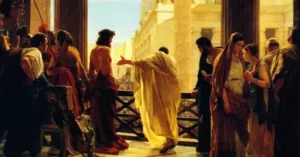
The events of Good Friday are dated roughly between 30–33 AD. On this day, Jesus Christ, the Son of God and Savior of the world, was betrayed by Judas Iscariot, arrested in the Garden of Gethsemane, subjected to mock trials, scourged, mocked, and finally crucified on a hill called Golgotha.
Four canonical gospels—Matthew, Mark, Luke, and John—painstakingly document the details of this climactic day. The political and religious tensions between Roman authorities, Jewish leaders, and the growing following of Jesus played a central role in orchestrating His death. Pilate, the Roman governor, though declaring Jesus innocent, succumbed to the pressure of the crowd, sentencing Him to be crucified.
But far from being a tragic historical misfortune, this day had been prophesied for centuries. The cross was not an accident—it was the fulfillment of divine purpose.
3. What Does “Good” Friday Mean?
To the natural eye, there was nothing “good” about that Friday. It was a day of suffering, injustice, and death. So, why has the Church come to call it Good Friday?
Some scholars suggest that the word “Good” evolved from “God’s Friday.” Others believe that “Good” reflects the holy and sacred nature of the day, signifying the good that came out of Christ’s sacrifice.
In Christian theology, the “goodness” of this Friday lies in the outcome: the redemption of mankind. It was the day when sin was paid for, death was defeated, and the gates of heaven were opened for all who believe.
4. The Theological Heart of Good Friday: Atonement and Redemption
The Bible clearly teaches that all have sinned and fall short of the glory of God (Romans 3:23). Sin separates us from God and demands judgment. But God, in His love, provided a solution—atonement through a perfect sacrifice.
Jesus Christ became that sacrifice. On the cross, He bore our sins, absorbing the wrath of God so that we could be forgiven and reconciled. This is captured profoundly in Isaiah 53:
“But he was pierced for our transgressions, he was crushed for our iniquities; the punishment that brought us peace was on him, and by his wounds we are healed.” (Isaiah 53:5)
The cross is not just a symbol of suffering—it is the altar of salvation. When Jesus cried out, “It is finished” (John 19:30), He was declaring that the price of sin had been paid in full.
5. The Seven Key Events of Good Friday
- The Betrayal and Arrest of Jesus – Judas leads soldiers to Gethsemane.
- The Religious Trials – Annas and Caiaphas interrogate Him.
- The Roman Trials – Pilate and Herod examine Him.
- The Scourging and Mockery – Jesus is flogged, crowned with thorns.
- The Journey to Golgotha – He carries His cross through the Via Dolorosa.
- The Crucifixion – Nails driven into His hands and feet.
- The Seven Last Words – Profound statements spoken from the cross.
These were not random occurrences but orchestrated steps in the divine plan of redemption.
6. The Cross and the Cosmic Battle
At the heart of Good Friday lies a cosmic battle—between good and evil, light and darkness, life and death. The crucifixion was more than a Roman execution; it was the turning point in the battle for human souls.
Colossians 2:15 says:
“And having disarmed the powers and authorities, He made a public spectacle of them, triumphing over them by the cross.”
The cross was the battlefield where Satan’s grip on humanity was broken. Jesus, by dying, conquered death itself.
7. Good Friday and the Old Testament Foreshadowing
The message of Good Friday is woven throughout the Old Testament:
- The Passover Lamb (Exodus 12): Jesus is the fulfillment of the lamb whose blood protected the Israelites.
- The Bronze Serpent (Numbers 21): Lifted up for healing, just as Christ was lifted up for our salvation.
- The Day of Atonement (Leviticus 16): The High Priest enters the Most Holy Place with blood; Jesus, our eternal High Priest, entered with His own blood.
Every shadow, every symbol, and every prophecy pointed to this day.
8. Why Good Friday Is Still Relevant Today
In our broken world filled with pain, betrayal, injustice, and despair, Good Friday speaks loudly:
- To the rejected – Jesus was rejected so you could be accepted.
- To the wounded – Jesus bore wounds to bring you healing.
- To the guilty – Jesus took your place.
The cross is still the answer to the questions of identity, purpose, and destiny. In it, we find forgiveness, restoration, and hope.
9. Good Friday and Personal Transformation
This day challenges us to reflect:
- What does the cross mean to me personally?
- Have I received the gift of salvation?
- Am I living in light of that sacrifice?
Paul says in Galatians 2:20:
“I have been crucified with Christ and I no longer live, but Christ lives in me.”
Good Friday is not just to be observed but to be experienced daily in our surrender to the crucified and risen Lord.
10. Good Friday in the Global Church
Christians around the world commemorate this day with solemnity:
- Processions in Latin America
- Tenebrae services (service of shadows) in Europe
- Fasting and reflection in Africa and Asia
Despite cultural differences, the message remains universal: the Lamb of God was slain for the sins of the world.
11. From Sorrow to Joy: Looking Forward to Easter
The story doesn’t end at the cross. Good Friday leads to Easter Sunday. Without the resurrection, Good Friday would be a tragic ending. But because Jesus rose, the cross becomes a symbol of victory.
“Weeping may endure for a night, but joy comes in the morning.” (Psalm 30:5)
This is the Christian paradox: death brings life, and sorrow turns into joy.
12. Conclusion: The Greatest Love Story Ever Told
Good Friday is God’s ultimate love letter to mankind, written not with ink but with the blood of His Son. It tells of a Savior who loved so deeply that He laid down His life for enemies so they could become children of God.
“Greater love has no one than this: to lay down one’s life for one’s friends.” (John 15:13)
On the darkest day in human history, the brightest light of divine love shone through.
That is why we call it Good Friday.
Call to Action: If this message touched your heart, share it with someone today. Let the message of the cross shine through your life. Feel free to leave your thoughts, questions, or testimony in the comments below. Visit us at www.gracetogospel.com
Internal Links: